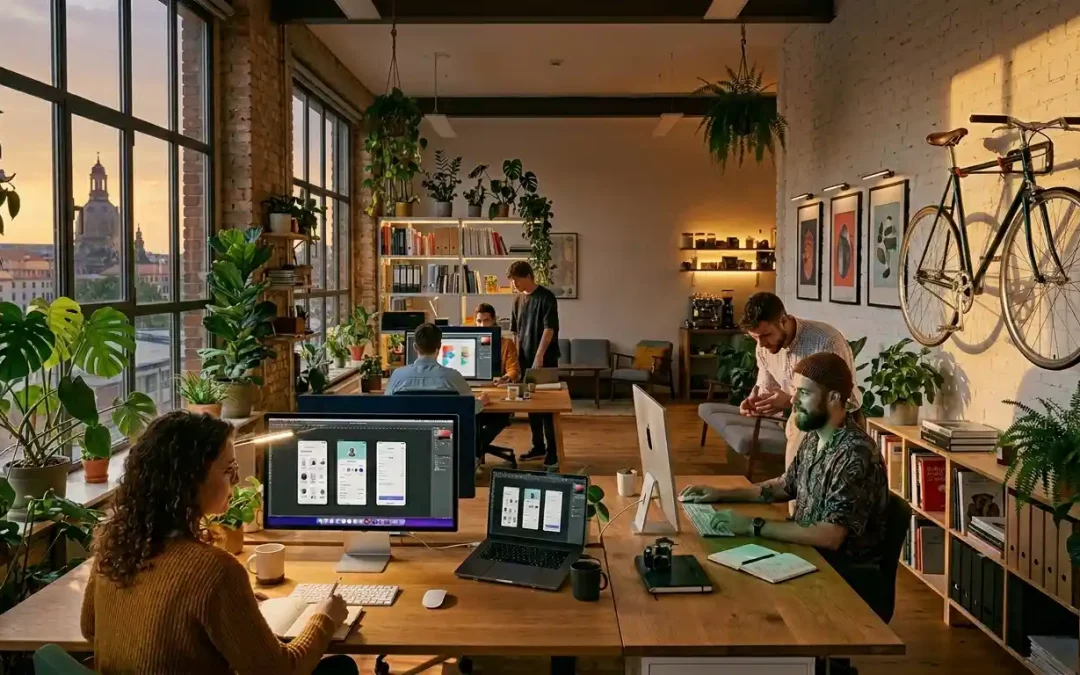
Why creativity needs a foundation – not an accounting department.
Space is the physical extension of the mind. Anyone who believes that excellent ideas arise in sterile cubicles between filing cabinets and fluorescent lights is confusing administration with creation. A design studio that looks like an accounting department commits treason against its purpose. Interior design is not decoration. It is the architecture of inspiration.+
The Dismantling: The Prison of Sterility
Most offices are trimmed for risk minimization and repetition. Gray carpets and ergonomic plastic chairs signal to the brain: here, things are administered, not dared. This is the visual veto against intuition.
In an environment that offers no haptics, no depth, and no history, the Immersion Factor withers. Accounting needs order for the past. Design needs structure for the future. If the space doesn’t breathe, the idea won’t either.
The Trap of Infantility
Equally deceptive, however, is the other extreme: the “Google office.” Colorful slides, ball pits, and primary colors are not signs of freedom. They are infantile noise. This playful approach attempts to mask the gravity of creation with the lightness of play. But true mastery requires no distraction. A foosball table does not create depth. It is a backdrop for diversion, while excellent design demands absolute presence. Those who work as if in a kindergarten will not build cathedrals.
The Immersion Factor: The Master’s Workshop
To understand how a creative space must act, we must look into the manufactories. A watchmaker’s workshop in Geneva or the Porsche design studio in Weissach are not “cool” offices. They are places of mastery.
A creative space must breathe the substance of the craft. It must be a haptic archive.
• Materiality: Raw concrete, solid wood, steel. These materials remind us of gravity and the truth of the object.
• The Haptic Archive: Shelves full of material samples, prototypes. Creativity needs the resistance of the physical world.
• The Light of Precision: No diffuse, uniform light. We need zones. Light for focus. Shadows for reflection.
The Synthesis: The Architecture of Calm
How does interior design clarify that creativity reigns here? Not through colorful beanbags. True Calm Authority in space is created through targeted placements:
1. The Workshop Logic: Large, heavy tables for both digital and analog drafts. Design is work, not play.
2. The Curation of Emptiness: Creativity needs unplayed surfaces. A room that fills every corner leaves no space for the next thought.
3. The Visibility of Becoming: Moodboards show: here, things are deconstructed and reassembled.
The Manifesto
The office is the first draft of an agency. When a customer enters the room, they must feel the quality of the work before they see the first pixel. A space that possesses depth demands depth.
Space is the foundation of thought. Design is the ordering of the environment. Those who want mastery must make it habitable.


Let's create something meaningful together
I love what I do - for me, design is less of a job and more of a calling. That's why I enjoy working with ambitious individuals and mid-sized businesses just as much as I do with global players. If you bring that same passion to your project, I’d love to hear from you. Let’s find out together how we can take your vision to the next level.