
The common notion of creativity is wrong. It is treated like a personality trait – something you either have or you don’t. Like height. Like a genetic inheritance you receive at birth, or simply don’t. This notion is convenient. And it is a lie.
The status quo: Creativity as myth
In agencies, companies, and creative teams worldwide, the same pattern repeats itself. A handful of people are designated “the creatives.” The others deliver briefings, budgets, and feedback. The hierarchy of ideas is fixed before the first meeting begins.
The result: mediocrity with a large budget.
The truly creative minds in the room – the strategist, the developer, the project manager – censor their ideas before they are even fully formed. Because no one has ever given them permission to be creative. And so the potential present in every room goes untapped. Preserved in fear.
What creativity actually is
The Greeks knew something we have forgotten. They did not speak of being creative. They spoke of receiving creativity. The poet was not a creator. He was a channel. The Muses spoke through him. Genius did not come out of him. It came toward him.
This sounds mythological. But it is precise phenomenology.
Every creative person knows this moment: you work, search, fail and then something appears. An idea. An image. A solution. It does not feel like your own achievement. It was not produced. It was received.
Neuroscience describes the same process, only in a different language. Research from Northwestern University and the University of California (published in Scientific Reports, 2015) shows that creativity emerges from the interplay of three major brain networks. The Default Mode Network – active during free association, daydreaming, and letting go. The Executive Control Network – responsible for evaluation, focus, and structure. The Salience Network – the filter that recognizes what is relevant.
Crucially, a large-scale study with over 2,400 participants (Communications Biology, 2025) found that creative ability is not predicted by intelligence but by the frequency of transitions between these networks. Creativity is not a state. It is a rhythm.
And this rhythm can be trained.
What craft, sport, and philosophy know
An architect does not design a building from nothing. He knows statics, materials, history, light. His creative output is a function of his accumulated knowledge. The same applies to the knife-maker who compresses centuries of craft culture into a single blade.
Creativity without substance is noise.
What I observe again and again in my work as a Creative Director: the strongest ideas do not emerge at the whiteboard. They emerge in the moment when someone takes a function out of its context and applies it elsewhere. The eraser that solves a client problem in the automotive sector. The surgeon whose operating protocol yields a better project management system than any Agile framework.
This is not magic. It is structure. It is what Edward de Bono called lateral thinking: the willingness to ignore categories and draw connections where none should exist.
But this willingness requires courage. And courage requires safety.
Permission as foundation
Google’s Project Aristotle – a multi-year study across more than 180 teams – sought the decisive factor for high performance. The researchers analyzed over 250 attributes: intelligence, experience, personality, team size. The result was clear and surprising in equal measure.
The strongest predictor of creative team performance was not talent. It was psychological safety. The certainty that a poorly formulated idea carries no consequences. That the absurd is heard before it is judged. Teams with high psychological safety outperformed others by 27 percent – in productivity, innovation, and satisfaction.
What Google verified empirically, every creative person knows from their own experience: you must give yourself permission to be creative.
This sounds simple. It is the hardest thing of all.
Because between the creative impulse and its visibility stands a censor. He goes by many names: reason, professionalism, modesty. He is the product of school systems that punish mistakes. Of briefings that expect answers before the questions have been asked. Of cultures that confuse conformity with competence.
Building a creative environment means dismantling this censor. Not through workshops. Through attitude. Through leadership that shows its own unfinished thoughts. That names its mistakes. That invites the absurd before the reasonable has had its say.
Divergence and convergence are not phases of a process. They are disciplines. Those who practise both simultaneously – who generate and evaluate in the same breath – destroy the raw material before it can take form.
The manifesto
Creativity is not the privilege of the few. It is the suppressed potential of the many.
Those who want to unlock it – in themselves, in teams, in organisations – do not begin with methods. They begin with a single decision: the permission to think the unfinished out loud. To take the absurd seriously. Not to kill the first thought before it has had a chance to breathe.
The Greeks were right. Genius does not come out of you. It comes toward you.
But you have to open the door.
Christoph Gey is a Creative Director based in Leipzig with a hub in Berlin. He works at the intersection of strategy, brand, and design – for companies that place substance above decoration.
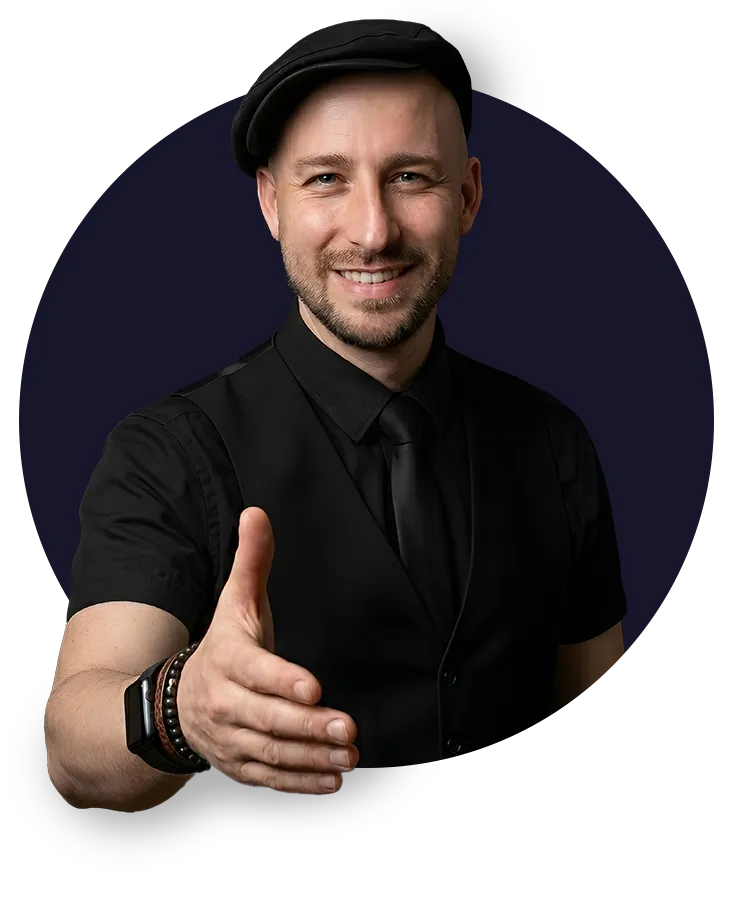
International Freelance Creative Director & Digital Product Designer
Let's create something meaningful together
I love what I do - for me, design is less of a job and more of a calling. That's why I enjoy working with ambitious individuals and mid-sized businesses just as much as I do with global players. If you bring that same passion to your project, I’d love to hear from you. Let’s find out together how we can take your vision to the next level.