
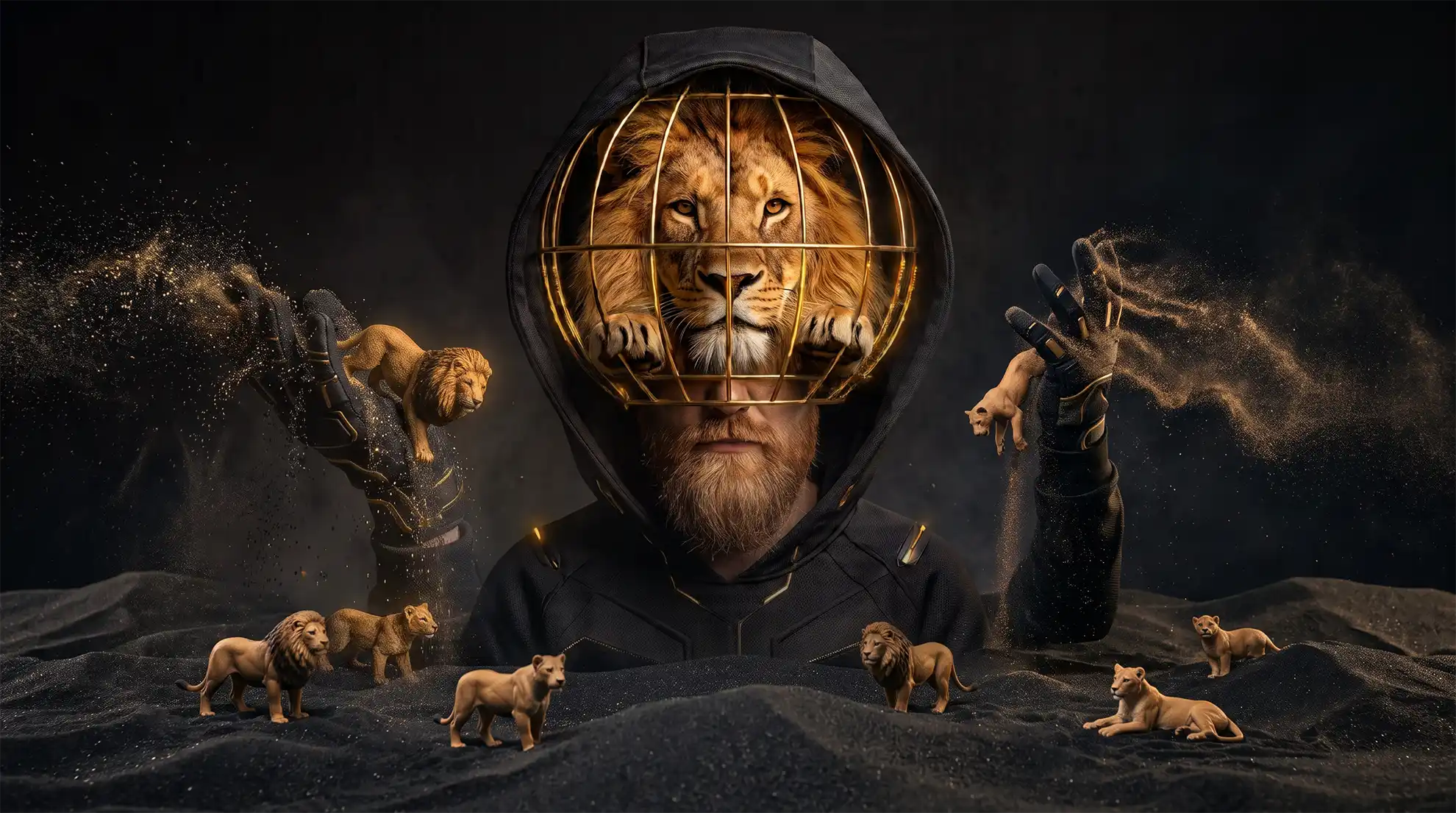
Essay — Leadership
Creative Leadership
15 tips learned in 15 years
Why some teams perform better than others.
Fifteen Years
in Teams
Every leader has a style of their own. And yet some teams perform better than others. Why?
In 15 years, I have seen teams celebrate success, and I have seen teams fail. I have led teams myself, and I have been a team member myself. Here are fifteen lessons I took from it.
Fifteen Tips
for Creative Leaders
1 Know your team
As a creative lead, you should know who is on your team. That includes professional strengths and weaknesses: Who is strong in branding? Who has a feel for typography? Who develops logos or websites? Soft skills matter just as much. Who tells you their honest opinion, even when you don't want to hear it? Who tends to exaggerate? Who quietly keeps morale up in the background?
Then there are the members who criticize every instruction from the lead. That tears a team apart. A few critical voices are healthy; we should always question ourselves. But when the dynamic tips into negativity, it drains energy exactly where you can't afford to lose it.
Stay attentive to what moves your people outside of work. That doesn't mean prying. It means having an open ear and sensing when someone is carrying something heavy. Then it may not be the moment to ask for more voluntary overtime. And the passions people have in their free time, whether chess, basketball or tango, often reveal a lot about how they think and how they work.
2 Keep the team small
Small teams often hit harder than large ones. Some tasks need mass, but those are the exception. Two or three very good all-round designers who combine motion, web and branding in one person inspire each other to peak performance, at least as long as ego doesn't get in the way. And they can cover for each other when someone is out.
The smaller the team, the fewer the alignments. Remote or on-site, it makes no difference: most of the time goes into coordination and clearing up misunderstandings. Still, budget for specialists. Not only for their expertise, but for the fresh air they bring with them.
3 Leave your ego at the door
Ego is a destructive force. It convinces the individual that he or she is the best, and pushes everything else aside. Ego kills the best ideas. Ego kills teamwork. Ego kills your own development.
As a designer, I am a service provider, and the word contains serving. A serving, humble heart is worth its weight in gold in our industry. Serving is often mistaken for weakness. But the Bible says that Jesus washed the dirty feet of his disciples. He served them. That is worth some thought.
4 Be a good role model
You can't demand from your team what you don't deliver yourself. You want them to be positive? Then be positive. You want them to show up on time for meetings? Then show up on time yourself. Don't preach water and drink wine.
5 Stay hands-on
Leaders tend to drift into pure strategy or pure organization. That is dangerous. I recommend that every creative lead keeps designing, at least part of the time. To stay fresh, to stay in the subject, to stay a little sharp.
6 Build a diverse team
A team lives on diversity, and not on principle, but for practical reasons. Imagine a gas station chain that wants to improve refueling and service at its locations. What does "better" mean? For a woman, refueling at night is something entirely different than for a man. The same goes for age, background or mobility. A diverse team sees more of the reality it designs for. It never works perfectly, but it is worth trying.
7 Give introverts room
Loud voices have their place. But equally important are people who don't start talking right away, who listen first and question themselves before they speak. My heart beats for them. Give them the space in the team to be heard and to dare to speak up.
8 Make work visible
Anyone who organizes makes work visible, whether with Monday, Jira, Trello or something else. I still remember the early days, when we didn't have that luxury. It was the Wild West. Jobs were overlooked, some team members were overloaded while others had nothing to do, and new requests kept landing on the team without deadlines. Today it is much more comfortable. It just shouldn't turn into bureaucracy. We are creatives, after all.
9 Shape your space
The space where you spend the majority of your life should spark creativity, in the office as well as at home. No cables lying around, no old food. It should be clean. One person likes minimalism and everything crisp; another puts figures on every surface. To each their own.
But working at a solid wood desk is different from sitting at a slab of particleboard. Being surrounded by inspiring books, art, sculptures, plants and beautiful pictures is different from sitting in one of those cold, mass-processing rooms. Your best work will never come out of the latter. Sorry, but that is how it is.
10 Spend time together
You don't have to spend every free minute together. That would be madness. But it is a fine thing to be surrounded every day by people you also enjoy being around privately. Nobody likes assholes, and nobody wants to work with them or spend time with them, not at work and not in their free time.
Go on trips together, go out for a nice dinner, partners included. Take a real interest in each other's lives. It strengthens the team spirit.
11 Keep moving
Anyone who does the same job for long enough goes blind to it and eventually just follows the rulebook. Passion and drive fade. Variety is the remedy: a pitch, a loan to another team, a new skill.
The same goes for training. It is hard to fit into the daily grind, especially when pitches are coming up. But in the long run, it is essential. It doesn't have to be an expensive workshop. Sometimes four hours a week for everyone to watch tutorials is enough.
12 Don't always take the shortest path
People like to walk the same paths until they are worn smooth. We repeat what has worked before, and we avoid pain. In doing so, we unfortunately optimize lateral thinking away: the questioning, the curiosity, the challenge.
The countermove starts in everyday life. Don't take the shortest way to work; take the most beautiful one. Brush your teeth with your weaker hand (see my essay "Calling for Brand Day"). Whoever deviates from the norm in daily life is more likely to do the same at work. And take an hour longer for a task than you need, to deliberately not be efficient.
13 The power of the stupid idea
Don't dismiss an idea as stupid too quickly. Out of ten stupid ideas, usually one excellent one grows. Not just a good one, an excellent one. If you don't allow the stupid ones, or don't see anything valuable at their core, you will never get there. You only have to recognize which idea is stupid and which is excellent. 😉
14 Recharge the battery
If you only produce output, you dry out. You get inspiration not only from other designers, but from other ways of thinking and other cultures. Don't eat spaghetti bolognese; eat spaghetti with spinach. Inspiration should be a spur. It should never make you feel small, or convince you that you will never reach other people's perfection.
There are many formats for it: a monthly breakfast with a guest speaker, team members presenting their own work or the work of others, freelancers supporting the team for a while, not because they have to, but because new conversations start that way.
15 Give yourselves an identity
See yourselves as a team of your own within the company or agency. Develop a logo, team shirts or a claim, aligned with the branding of the house. You remain part of a whole. 😉
And then there is music. I loved it when we went into the pitch room at isobar: all windows open, Micha's playlist at full volume. Music lifts you up. It just shouldn't drive others crazy. Then it brings looseness.
Have fun
Every team is different, and every topic brings its own problems, strengths and weaknesses. Everyone on the team should know the overarching strategy of the company and understand what their work contributes to. The goal should be more than profit maximization.
The time we spend at work is our life time. It is very valuable, and we don't get it back. So don't work only for money; work for something bigger, and enjoy it. Building a good team is not only the leader's job. It is everyone's.
Have fun, and look after each other.

About the Author
These essays are written by Christoph Gey, an independent Creative Director and Digital Product Designer based in Germany. With over 15 years of industry experience, his work focuses on the strategic intersection of premium branding and complex digital products.
Within these articles, he explores the deeper mechanics of design - ranging from brand strategy and user experience to neuroaesthetics. True to the philosophy that form follows meaning, these insights are crafted for decision-makers who believe that enduring brands demand substance, not just decoration.
MORE ESSAYS
IKEA EFFECT – design psychology explained
A wobbly chair can be irreplaceable. A flawless handbag can end up at the back of a closet. The IKEA effect explains why and what it means for design in an age of effortless output. Explore the neuroscience behind it.
Uncanny Valley – AI authenticity
AI-generated images can look flawless and still feel wrong. In a live A/B test with 3,680 page views, the version with real people earned 13% more clicks. This essay explains the Uncanny Valley in the age of generative AI and why brands now face a new question: not “Does it look real?” but “Is it real?”
Win every pitch
Fifteen years of helping agencies win their dream clients, distilled into 15 tips. Why winning shouldn’t be the goal, why a pitch is only a first meeting, and what really makes a client say yes.
The Liturgy of the Interface
Church bells and push notifications, confession and the Genius Bar: an essay on the psychological architecture shared by ritual and interface design and where the analogy breaks down.
SELECTED WORK
A curated selection of branding and digital product design projects. My work focuses on creating coherent brand experiences that bridge the gap between human perception and functional utility, helping organizations translate complex strategic goals into enduring digital products.



International Freelance Creative Director & Digital Product Designer
Let's create something meaningful together
I love what I do - for me, design is less of a job and more of a calling. That's why I enjoy working with ambitious individuals and mid-sized businesses just as much as I do with global players. If you bring that same passion to your project, I’d love to hear from you. Let’s find out together how we can take your vision to the next level.