
Essay — Behavioral Design
The Liturgy of the Interface
Why Good Products Feel Like Rituals
On the psychology shared by ritual and interface design — and where the comparison stops working.
Theorem
The Argument
There is an architecture older than any interface. It has calmed people for millennia in the face of a world they cannot control.
That architecture is built from ritual, repetition, and a clearly defined moment of relief. We recognize it in the church. We miss it in the App Store.
The claim: digital products work best when they reproduce the liturgical mechanics that religious practice has relied on for millennia — the human need to turn chaos into order, and to hand the burden of constant decision-making to something larger than oneself. Deliberately precise: the comparison here is not theology, the doctrine of the divine. It is liturgy — the choreography of belief, practiced daily. Good design doesn’t end at pixels. It begins in the sociology of ritual.
Deconstruction
Where the Analogy Breaks
Before the thesis can carry weight, it has to survive a stress test. The obvious version of this argument is wrong.
2.1 The Naive Claim
TheoryThe easy equation goes: religion soothes, apps soothe, therefore apps are religion. It doesn’t survive scrutiny. At its core, religion demands surrender to something unavailable — something transcendent that refuses to arrive on command. Good UX design wants the opposite: total availability, zero friction, instant gratification. A god who answers every prayer on schedule stops being a god. He becomes a vending machine.
2.2 The Precise Claim
PracticeSo the analogy collapses at the level of the object. It holds at the level of function. Religion and digital product design aren’t solving the same metaphysical problem, but they draw on the same psychological architecture to address a related one: the unbearableness of uncertainty. The difference is scale. Religion promises meaning in the face of the unavailable. Interface design promises relief in the face of the trivial. Both run on the same mechanism — trigger, ritual, variable confirmation — for problems of entirely different magnitude. That, not the hasty equation, is the version of the thesis worth defending.
Deep Dive
The Mechanism
If mechanism, not object, is what carries the comparison, it can be described precisely — and grounded in three established models of behavioral psychology.
3.1 Trigger and Ritual
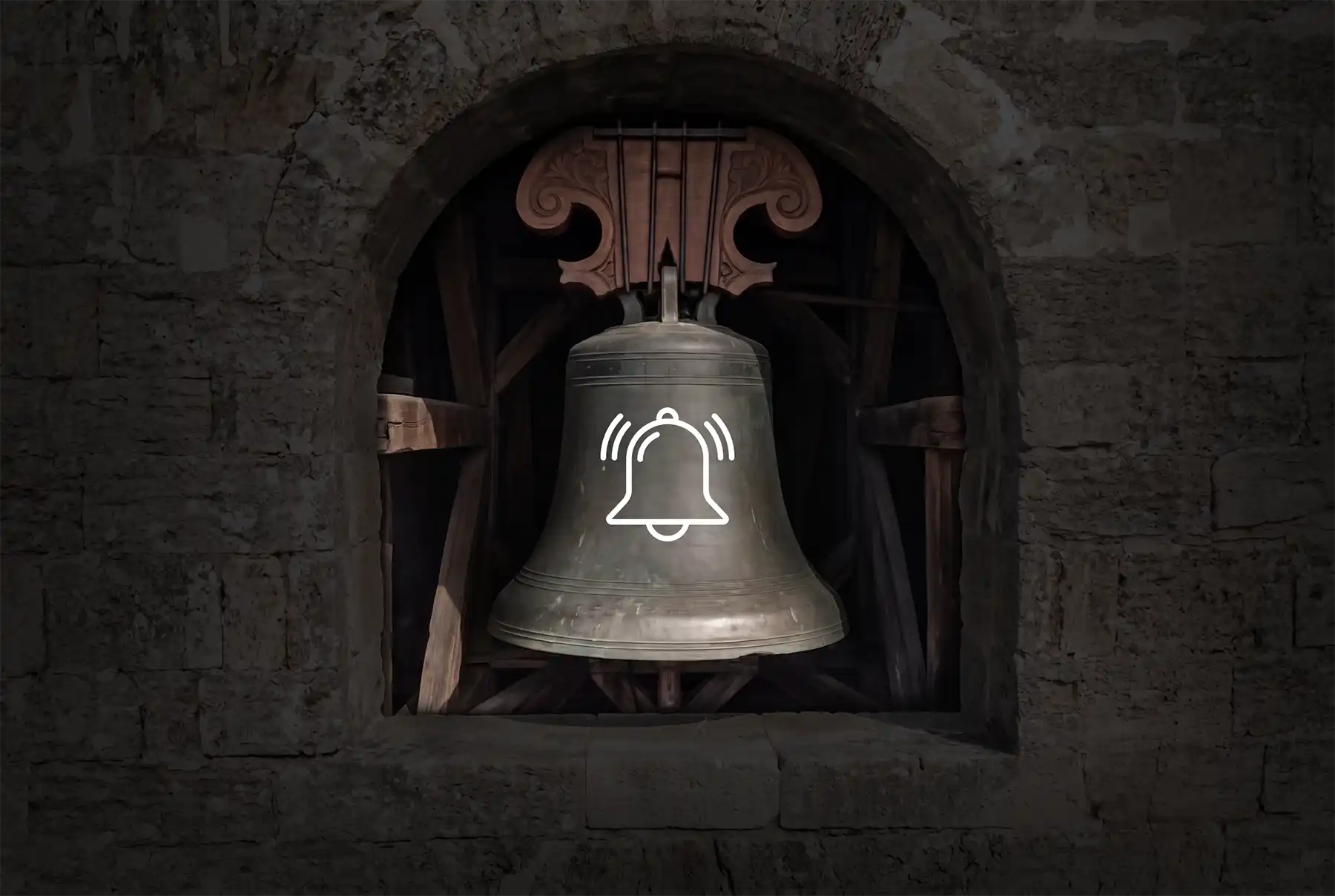
The church bell is the trigger. It creates the sense of obligation to act now. Its digital equivalent is the push notification, or the threatened loss of a streak. The micro-interaction, in turn, is the ritual feedback that gives an action its weight. When a congregation says “Amen,” an action is sealed neurologically. When Apple Pay confirms a purchase with a quiet chime and a soft haptic pulse, the same thing happens, structurally.
Three Foundations
- Nir Eyal’s Hook Model: trigger, action, variable reward, investment — a cycle that bell, prayer, uncertain answer, and offering complete just as notification, open, new likes, and one’s own data do.
- B.F. Skinner’s variable ratio schedules: uncertainty is what makes a behavior compulsive. A prayer isn’t always answered; a pull-to-refresh doesn’t always deliver a message — that unpredictability is what forces repetition.
- B.J. Fogg’s behavior model, B = MAP: Motivation × Ability × Prompt. Good design mostly works on Ability — one-click buy, Face ID, autofill. The lower the effort, the faster an action becomes a ritual.
3.2 Apple, Revisited
Apple remains the best-known case of liturgical brand-building, even though the comparison has become a cliché by now: the keynote with its fixed dramaturgy, the Apple Store as a space built on sacred architecture, the Genius Bar where you confess a problem and ask for absolution — “I have sinned, and spilled coffee on my MacBook.” The famous line, “one more thing,” belongs to the Jobs era; under Tim Cook it has become a rare exception, most recently for the Vision Pro. The liturgical need itself hasn’t disappeared. It just changed its formula.
3.3 New Temples
More interesting than the now-canonized Apple example are the rituals forming right now. The TikTok algorithm behaves like an unpredictable god of fate: invisible, all-knowing about your data, yet entirely arbitrary in its judgments — whether a video is seen 200 times or 2 million is beyond anyone’s control, only hoped for. Duolingo’s owl plays a different religious role: the punishing, nagging god who reminds you, by push notification, of neglected duty. Both cases show the same thing: the liturgical structure hasn’t exhausted itself. It keeps finding new temples.
Synthesis
Who Gets to Decide
The mechanism is settled. The real question for brand and product leaders isn’t whether to use this knowledge — they already do, the moment they design an onboarding flow or a reward screen. The question is what for.
Cults of Exploitation — When Ritual Becomes a Trap
- Doomscrolling: the endless feed as a ritual with no closure, none of the relief it promises.
- Slot-machine mechanics in swipe-based dating: variable reward, decoupled from any real investment.
- Manufactured FOMO: countdown timers and “only 2 left” badges with no real connection to actual stock.
A ritual that creates real value — mastery, connection, meaning — is structurally no different from one optimized purely for time-on-app. The difference lies entirely in what the user is left with once the ritual ends: richer, or just emptier and back in the app? Trust is the actual currency — and trust doesn’t come from exploiting a psychological mechanism. It comes from using it honestly, in the user’s service.
Manifesto
The Weight of Building Rituals
Whoever designs an interface designs a ritual for someone else’s life. That isn’t an exaggeration. It’s the sober consequence of what we know about triggers, repetition, and relief.
Good brands don’t build cults around themselves. They build rituals that actually move the people who take part in them forward. Designing with that seriousness isn’t an aesthetic concern. It’s a stance.
The Only Question That Matters
The question is never whether a product creates a ritual. Every good product does.
The only question worth asking is who that ritual leaves behind at the end — a richer person, or just a loyal user.

About the Author
These essays are written by Christoph Gey, an independent Creative Director and Digital Product Designer based in Germany. With over 15 years of industry experience, his work focuses on the strategic intersection of premium branding and complex digital products.
Within these articles, he explores the deeper mechanics of design - ranging from brand strategy and user experience to neuroaesthetics. True to the philosophy that form follows meaning, these insights are crafted for decision-makers who believe that enduring brands demand substance, not just decoration.
MORE ESSAYS
Uncanny Valley – AI authenticity
AI-generated images can look flawless and still feel wrong. In a live A/B test with 3,680 page views, the version with real people earned 13% more clicks. This essay explains the Uncanny Valley in the age of generative AI and why brands now face a new question: not “Does it look real?” but “Is it real?”
Win every pitch
Fifteen years of helping agencies win their dream clients, distilled into 15 tips. Why winning shouldn’t be the goal, why a pitch is only a first meeting, and what really makes a client say yes.

Scarcity and luxury brand discipline
Scarcity isn’t one tactic – it’s three. From fake e-commerce timers to Labubu’s collapse to Chanel’s century-long price discipline, here’s what actually separates them.
Louis Vuitton Design Systems
Louis Vuitton never chose between reach and exclusivity. Iit built a system that separates the two. A design-systems lesson for brand and product teams.
SELECTED WORK
A curated selection of branding and digital product design projects. My work focuses on creating coherent brand experiences that bridge the gap between human perception and functional utility, helping organizations translate complex strategic goals into enduring digital products.


International Freelance Creative Director & Digital Product Designer
Let's create something meaningful together
I love what I do - for me, design is less of a job and more of a calling. That's why I enjoy working with ambitious individuals and mid-sized businesses just as much as I do with global players. If you bring that same passion to your project, I’d love to hear from you. Let’s find out together how we can take your vision to the next level.