
Essay — Psychology of Value
The IKEA Effect
Why Devotion Makes Things Priceless
Value is not bought. It is built.
The Price and the Value
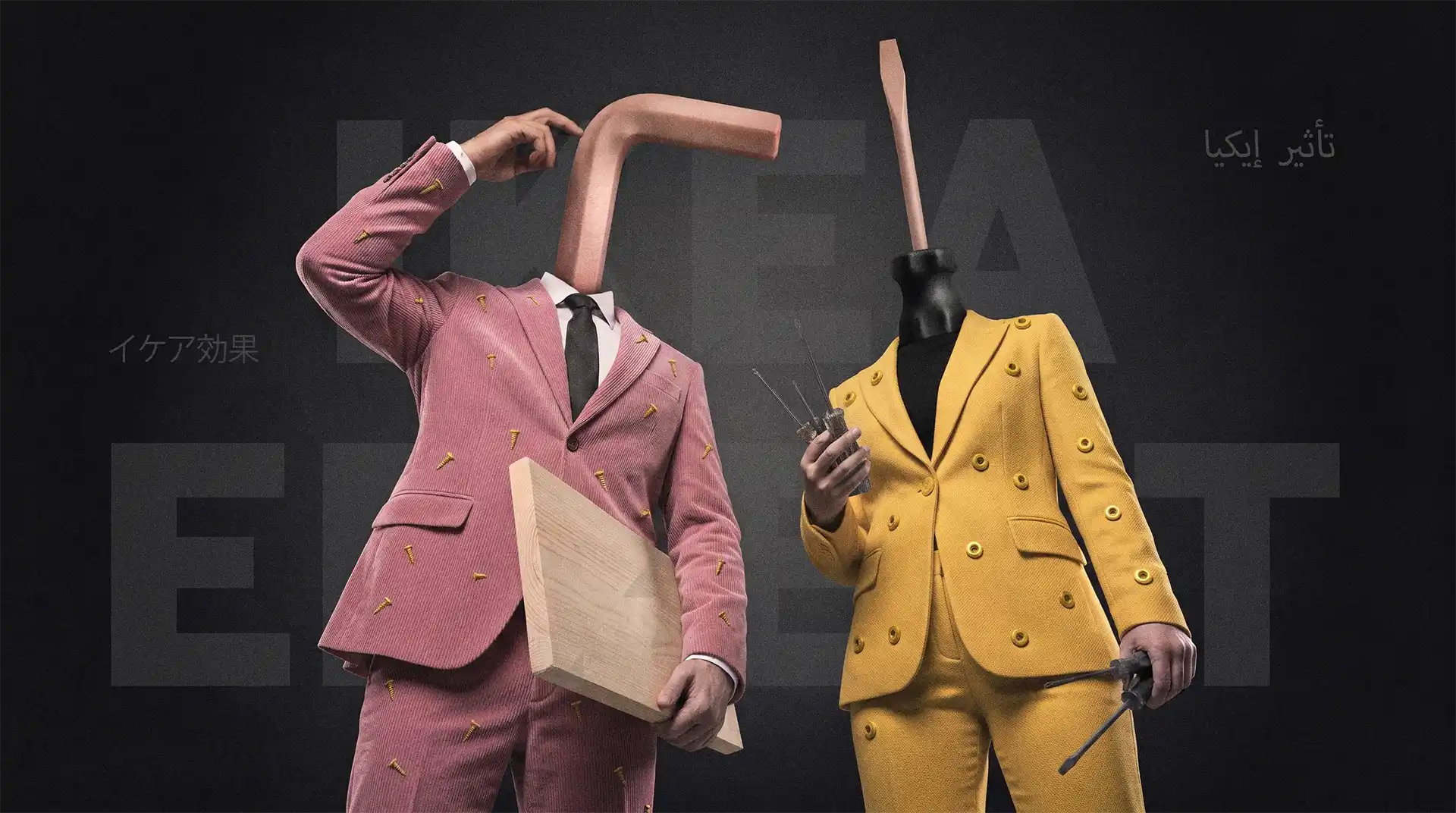
What the IKEA effect describes
A price can be calculated. Meaning cannot. The IKEA effect shows where the two part ways.
The price of an object is a simple number. Material costs, supply chain, margin, supply and demand. You can calculate it. The felt value refuses the formula. A wobbly wooden chair can be irreplaceable to its owner. A flawless designer handbag can vanish into a closet within weeks.
What gives objects meaning? Behavioral economics points to two opposing sources. The first is effort: we value what we have made ourselves. The second is distance: we value what stays out of reach. Both explain why people attach to things. They run on opposite logic.
1.1 The Study
The term comes from Michael I. Norton (Harvard Business School), Daniel Mochon (Tulane University) and Dan Ariely (Duke University). Their paper, "The IKEA Effect: When Labor Leads to Love," appeared in 2012 in the Journal of Consumer Psychology. Participants built simple objects: IKEA storage boxes, Lego sets, origami cranes. The researchers then ran auctions to measure what each person was willing to pay.
The results were clear.
- Higher willingness to pay. People who had assembled an IKEA box bid about 63% more for it than others bid for the same box.
- Distorted self-image. Participants rated their amateur origami almost as highly as work by experts. Outsiders did not share that view.
- The condition of completion. The effect needs a finished object. When participants failed, or had to take the work apart again, the gain disappeared.
1.2 The Mechanism
The common explanation is cognitive dissonance. Whoever invests time, focus and frustration faces an inner conflict if the result turns out mediocre. The mind resolves it by upgrading the result. A second motive sits underneath: the need for self-efficacy. We want to feel that our actions leave a mark.
The Legend of the Egg
From myth to market principle
The best-known story on the subject is too good to leave unchecked.
2.1 The Cake Mix
The tale goes like this. In the 1950s, American food companies launched ready-made cake mixes. You only added water. Sales fell short of expectations. The makers removed the powdered egg from the recipe. Now the baker had to crack a fresh egg. Sales rose.
The story is usually credited to the motivational researcher Ernest Dichter, sometimes to Edward Bernays. Its historical record is contested, and the details shift with each retelling. As a parable it still works. It shows what the IKEA effect later made measurable: a product that takes away all the work also takes away the pride.
2.2 The Principle in Today's Market
Modern products and services use this dynamic on purpose to create attachment.
- Meal kits like HelloFresh. The prep is done. The last minutes at the stove remain with the customer. The dish tastes better because he "cooked it himself."
- Build-a-Bear Workshop. Children choose fur, filling and heart, then stuff the toy themselves. Emotional value and price tolerance rise.
- Interactive onboarding. Whoever sets up dashboards in an app like Notion invests work. A digital lock-in follows.
- Co-creation workshops. A concept the client helped shape is a concept the client defends internally. Not-invented-here, turned positive.
For designers, this has a practical consequence. Good products do not remove effort everywhere. They decide where a small share of the work remains.
Luxury, Craft and the Flaw
Two roads to value
A luxury handbag and a self-sewn pouch create meaning in opposite ways.
3.1 Distance What Luxury Sells
No buyer of a Louis Vuitton bag cuts the leather. Still, such objects fetch five-figure sums. Luxury follows the reverse psychology of the IKEA effect. Three sources carry its value.
- Outsourced mastery. The buyer pays to avoid the work. He acquires the lifetime craft of other masters. His own hands would devalue the object.
- Social signal. The luxury bag speaks outward. It shows purchasing power and belonging.
- Artificial scarcity. Waiting lists and price barriers build the myth of the unreachable.
The IKEA effect creates value through appropriation: anyone can build it, but it is mine. Luxury creates value through distance: hardly anyone can own it, and it stays out of reach.
3.2 Proximity Making It All Yourself
The classic IKEA effect remains a compromise. You assemble prefabricated parts by rigid instructions. The skeleton is industrial. The freedom is small.
What happens when you leave that path? When you design the bag, choose the leather, cut the pattern and set every stitch yourself? Two values separate. The market value falls toward zero. The logo, the standardization and the warranty are missing. Nobody pays the hourly wage the work contains. The personal value rises to its maximum. The object becomes an artifact of your own identity. It is unsellable because it is irreplaceable.
3.3 The Aesthetics of the Flaw
A luxury bag lives on the illusion of perfection. Every flaw in finish ruins its status. Handmade work runs the other way. The crooked seam is not a defect. It recalls the moment the needle broke, the frustration, and the decision to keep going.
Related is the pratfall effect, described by the psychologist Elliot Aronson in 1966. A competent person becomes more likable after a small blunder. Applied to objects, this stays an analogy, not proof. The observation holds anyway: the imperfect anchors a thing in the reality of its maker.
The Devaluation of Effortlessness
What this means for our time
We are building a world that asks for almost no effort. That has a price.
Meals arrive at the push of a button. Images generate themselves. AI writes the text. Interfaces are tuned for comfort. Most of this is a gain. But if the psychological value of a result is tied to the effort we put into it, effortlessness has a side effect. What arises without resistance is discarded without hesitation, or forgotten.
Three attitudes can be told apart.
- Luxury tries to buy meaning with money and foreign excellence.
- The IKEA effect ties us back to things through small doses of work.
- True making is a quiet resistance to arbitrariness. It trades comfort for meaning.
Devotion Cannot Be Bought
The deepest bond with things does not form in the purchase. It forms in the making. This holds for a chair, a concept, a brand.
Anyone who designs should ask one question: where may a person still take part? Not everywhere. But where their effort can mean something.
Value cannot be delivered. It has to be built.
Sources: Norton, M. I., Mochon, D. & Ariely, D. (2012): The IKEA Effect: When Labor Leads to Love. Journal of Consumer Psychology, 22(3). Aronson, E., Willerman, B. & Floyd, J. (1966): The effect of a pratfall on increasing interpersonal attractiveness. Psychonomic Science, 4.

About the Author
These essays are written by Christoph Gey, an independent Creative Director and Digital Product Designer based in Germany. With over 15 years of industry experience, his work focuses on the strategic intersection of premium branding and complex digital products.
Within these articles, he explores the deeper mechanics of design - ranging from brand strategy and user experience to neuroaesthetics. True to the philosophy that form follows meaning, these insights are crafted for decision-makers who believe that enduring brands demand substance, not just decoration.
MORE ESSAYS

Creative Leadership – 15 tips
In 15 years I came a long way. I have seen teams succeed and teams fail. Here are 15 tips from 15 years of experience to make you a better design leader for your team.

Uncanny Valley – AI authenticity
AI-generated images can look flawless and still feel wrong. In a live A/B test with 3,680 page views, the version with real people earned 13% more clicks. This essay explains the Uncanny Valley in the age of generative AI and why brands now face a new question: not “Does it look real?” but “Is it real?”
Win every pitch
Fifteen years of helping agencies win their dream clients, distilled into 15 tips. Why winning shouldn’t be the goal, why a pitch is only a first meeting, and what really makes a client say yes.
The Liturgy of the Interface
Church bells and push notifications, confession and the Genius Bar: an essay on the psychological architecture shared by ritual and interface design and where the analogy breaks down.
SELECTED WORK
A curated selection of branding and digital product design projects. My work focuses on creating coherent brand experiences that bridge the gap between human perception and functional utility, helping organizations translate complex strategic goals into enduring digital products.



International Freelance Creative Director & Digital Product Designer
Let's create something meaningful together
I love what I do - for me, design is less of a job and more of a calling. That's why I enjoy working with ambitious individuals and mid-sized businesses just as much as I do with global players. If you bring that same passion to your project, I’d love to hear from you. Let’s find out together how we can take your vision to the next level.