
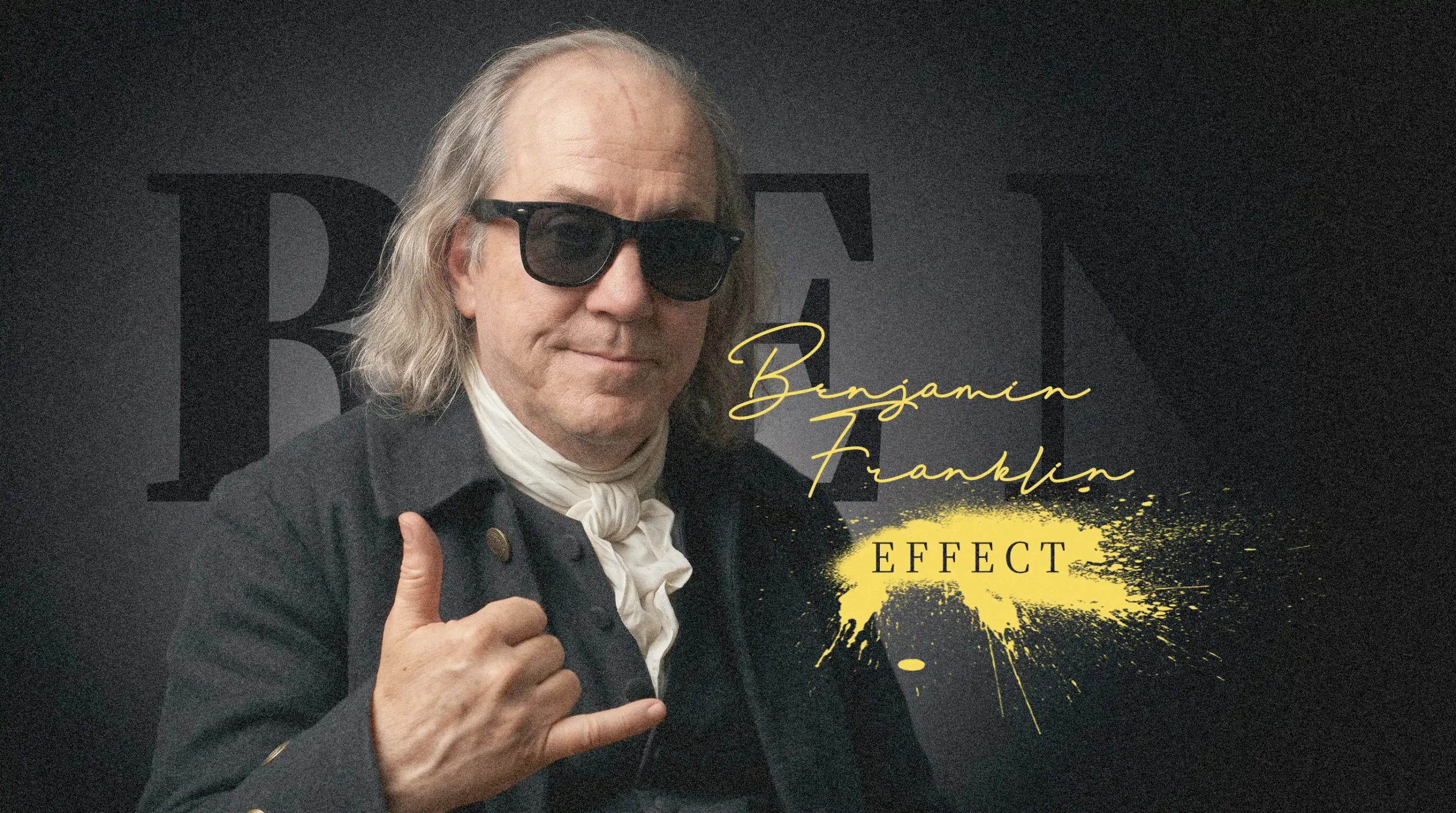
Essay — Psychology & Design
The
Ben Franklin
Effect
An essay on psychology, brands and interfaces.
The Theorem
What the Ben Franklin effect is
We believe liking leads to helping. The Ben Franklin effect claims the opposite.
Pennsylvania, 1736. Benjamin Franklin is elected clerk of the provincial assembly. A powerful member opposes him. He gives a long speech against him. Franklin wins the vote anyway. He does not want to keep the enemy.
Franklin does not flatter. He writes the man a note. He asks to borrow a rare book from his library for a few days. The man sends it at once. Franklin returns it after a week, with a second note and a clear word of thanks. At the next meeting, the member speaks to him. For the first time. They stay friends until the end of their lives.
Franklin calls this an old maxim. In his autobiography it reads: "He that has once done you a kindness will be more ready to do you another, than he whom you yourself have obliged." Today the phenomenon is called the Ben Franklin effect, also the Benjamin Franklin effect.
The definition is short. People like someone more once they have done that person a favor. The effect sits in the mind of the helper. Not in the mind of the receiver. That is what makes it unfamiliar: the request creates the closeness. The gift alone does not.
Franklin's story is an anecdote. Not an experiment. The evidence comes in 1969, from a study by Jon Jecker and David Landy, published in the journal Human Relations. Students win money in a contest. Then come three conditions. In the first, the experimenter asks them in person to give the money back. He says he paid it from his own pocket and is running short. In the second, a secretary asks on behalf of the department. The third group is not asked at all.
The result: those who helped the experimenter personally liked him most. The control group landed in the middle. Those asked through the secretary liked him least. An impersonal request lowers liking. A personal one raises it.
The Teardown
How the Ben Franklin effect works in people
Intuition says: liking first, helping second. Research shows it often runs the other way.
The effect rests on three mechanisms. The first is cognitive dissonance, described by Leon Festinger. Two thoughts do not fit together: "I don't like this person" and "I helped him." The conflict creates tension. The action cannot be undone. The attitude can. So the attitude changes. The brain rewrites the story: I helped him, so he must be worth it.
The second mechanism is self-perception. People also read their feelings from their own behavior. Those who help conclude: I seem to like him.
The third comes from a later study. The psychologist Yu Niiya of Hosei University in Tokyo tested the effect with Japanese and American participants. A direct request increased liking for the person asking. Unrequested help did not. Niiya's reading: a request is a signal. It tells the other person that you seek their company. The person asked returns that signal.
2.1 The Conditions
TheoryFive conditions can be derived from the studies and from Franklin's approach. If one is missing, the effect weakens.
- Free choice. The person asked decides for themselves. Pressure removes the dissonance, because the act is then explained: I had to.
- A personal request. Jecker and Landy show that a go-between reverses the effect.
- A small scope. Lending a book is easy. A burden creates resentment instead of closeness.
- Recognition. Franklin chose a book the man was proud of. The request honored his passion.
- Thanks. Franklin returned the book and thanked him in writing. The circle closed.
2.2 The Flip Side
The mechanism also works in the dark direction. In 1971, John Schopler and John Compere had participants teach students, once kindly, once harshly. Afterwards the teachers found the students they had praised more likable than those they had criticized. We devalue those we have harmed. Dissonance works in both directions.
Mentoring follows the same pattern. Those who invest time in a person believe in that person more. The investment justifies itself.
2.3 The Limits
The evidence is thinner than the internet suggests. Franklin's account is self-reported. The studies are old and small. So is Niiya's replication. The effect is plausible and supported more than once. It is not a law of nature. A request that burdens can damage the relationship.
Deep Dive
How companies use the Ben Franklin effect
Companies do not ask out of weakness. They ask because a request binds.
3.1 Sales and Customer Relationships
PracticeClassic sales gives: discounts, extras, samples. Research on favors suggests a second route. Simon Blanchard, Kurt Carlson and Jamie Hyodo studied the favor request effect. Their work appeared in the Journal of Consumer Research. It shows that a salesperson in a negotiation can improve the odds of closing the deal simply by asking for a favor. Nothing has to be given up front.
In practice this looks unspectacular. A service provider asks a client for a referral. A founder asks a customer for advice on a new feature. That flatters the person asked, because it recognizes their expertise. It binds them, because they are now invested.
3.2 Brands That Let Customers Contribute
The best-known example is the "Do Us a Flavor" campaign by Lay's. Customers suggest new chip flavors and vote on them. The brand gains ideas. More important is what it gains on the side: people who helped want the result to succeed. They buy the flavor they helped shape. The Ben Franklin effect and the IKEA effect interlock here. The request creates liking. The contribution creates value.
Digital platforms live on the same principle. Wikipedia, Stack Overflow and map services with user contributions ask their users for help. Those who correct, rate or answer move from consumer to participant.
3.3 Leadership and Collaboration
The pattern also works inside a company. A leader who asks a team member for advice signals trust. The team member invests time and judgment. Their attachment to the project grows. Those who exercise authority only through instruction give this route away.
Deep Dive
The Ben Franklin effect in UX and UI design
An interface cannot borrow a book. It can ask for decisions, contributions and opinions.
An honest note first: in UX design, the Ben Franklin effect is not a discipline of its own. It overlaps with the principle of commitment and consistency, which Robert Cialdini described in 1984, and with the IKEA effect. In practice the patterns are hard to separate. Those who keep them apart design more deliberately.
4.1 Onboarding as the First Request
PracticeA product's first request is the sign-up. Good products then ask small questions. Which language? Which goal? How much time? Duolingo collects such micro-decisions before it asks for a bigger commitment like a learning streak. Canva shows fitting templates based on the answers given at sign-up.
Two mechanisms work together. The answer is a small favor to the product. The response, "Based on your answer…", closes the circle like Franklin's thank-you note.
4.2 Ratings, Feedback and Community
Interfaces ask for ratings, feedback and contributions. Most do it badly. The standard is an anonymous dialog: "Rate us!" Jecker and Landy offer a hypothesis for why this works poorly. The secretary's request lowered liking. A system without a sender is the digital secretary. It is a hypothesis, not proof for UI. But it fits what Niiya found: the personal, direct request carries the effect.
Timing matters too. A request after a moment of success meets satisfaction. A request in the middle of a task meets irritation.
4.3 Thanks as an Interface Element
Franklin returned the book and wrote a second note. Most interfaces forget this step. The form is submitted, then silence follows. A concrete thank-you closes the loop: "Your suggestion improved this feature." The person sees that their help had an effect. That strengthens the justification for the next act of help.
4.4 Five Principles for Design
Method- Start small. The first request costs seconds, not minutes.
- Show a sender. A person or a clear name works better than an anonymous dialog.
- State the reason. "We are building X. Will you help us with Y?" is more concrete than "Give feedback".
- Leave the choice. Declining is equally visible. Those who agree only under pressure do not develop liking.
- Thank and show. A confirmation and, where possible, a visible result.
4.5 Where It Tips
The same mechanics can be abused. "Confirmshaming" phrases the refusal as self-accusation. Forced ratings, hidden decline buttons and commitments the user never entered freely are dark patterns. They create compliance, but not liking. The effect needs free choice. Without it, only friction remains.
Synthesis
One principle at three scales
From the handshake to the onboarding screen, the same sequence runs: contribution, investment, bond.
With Franklin, the contribution is a book. With a brand, it is a flavor. In an interface, it is a choice, a rating, a correction. The mechanism stays the same. Those who give something must justify it to themselves. The justification is called liking.
The difference between relationship and manipulation lies in the benefit. Does the person asked profit too? Franklin honored the member's passion. Lay's lets customers bring ideas to life. A good interface improves with the user's contribution. Where only one side wins, the request tips into tactics.
5.1 Frequently Asked Questions About the Ben Franklin Effect
- What is the Ben Franklin effect? A psychological phenomenon: those who do someone a favor like that person more afterwards.
- How does the Ben Franklin effect work? Mainly through cognitive dissonance. The helper justifies their help to themselves and rates the receiver more positively.
- Are there studies on it? Yes. Jecker and Landy published the best-known one in 1969. Yu Niiya later replicated the effect with Japanese and American participants. The studies are small.
- How do you use the effect at work? With small, personal and voluntary requests, such as asking for advice or expertise. An honest thank-you follows.
- What does the effect have to do with UX design? Interfaces ask for input, ratings and contributions. Personal requests, good timing and visible thanks strengthen the bond.
Manifesto
Ask. Then thank.
Relationships do not arise only from what we receive. They arise from what we give.
Franklin understood this before it had a name. He did not give his opponent a compliment. He gave him a task he could grow into.
For designers, this means: every request is a design. It has a sender, a moment, a size and a tone. It can be designed carelessly or with care.
The effect rewards care. It punishes tactics. Those who ask for help must be ready to honor it.

About the Author
These essays are written by Christoph Gey, an independent Creative Director and Digital Product Designer based in Germany. With over 15 years of industry experience, his work focuses on the strategic intersection of premium branding and complex digital products.
Within these articles, he explores the deeper mechanics of design - ranging from brand strategy and user experience to neuroaesthetics. True to the philosophy that form follows meaning, these insights are crafted for decision-makers who believe that enduring brands demand substance, not just decoration.
MORE ESSAYS

Von Restorff Effect
The Von Restorff effect says the odd one out is remembered. But a brand that only looks different, without changing in substance, trades trust for attention. A look at the neuroscience, UX practice and the trap of cosmetic rebranding.

Pratfall Effect – neuroscience meets design
Perfection earns admiration. Honesty earns trust. A creative director on the Pratfall Effect, a confession to his boss over a beer, and why the brands we believe are the ones that admit what they are not.
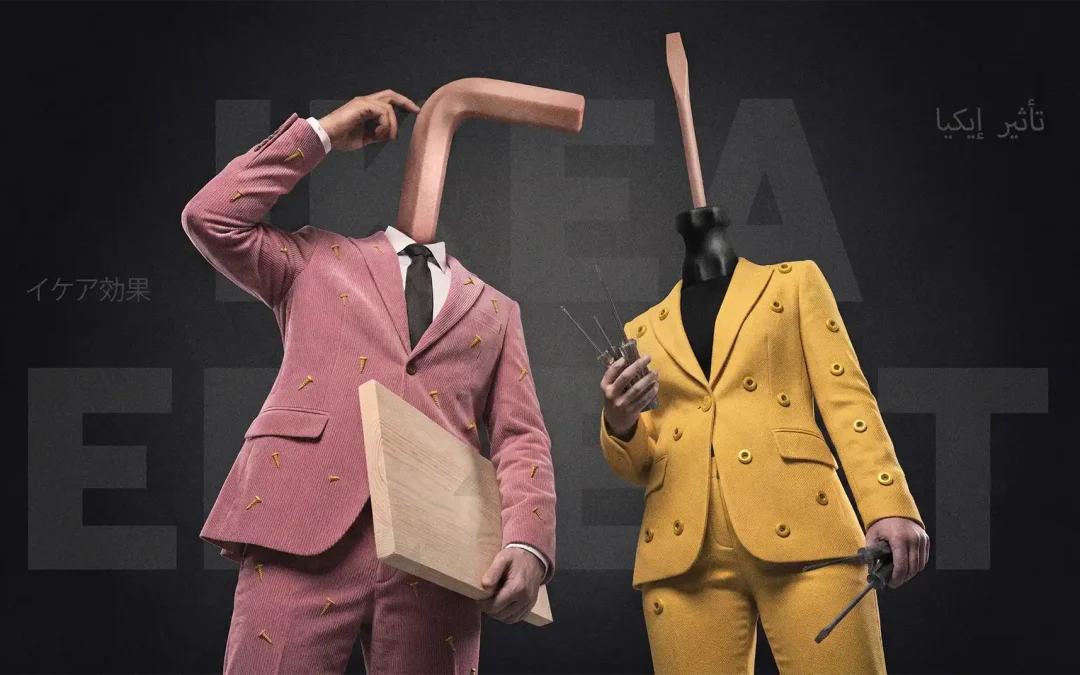
IKEA Effect – design psychology explained
A wobbly chair can be irreplaceable. A flawless handbag can end up at the back of a closet. The IKEA effect explains why and what it means for design in an age of effortless output. Explore the neuroscience behind it.

Creative Leadership – 15 tips
In 15 years I came a long way. I have seen teams succeed and teams fail. Here are 15 tips from 15 years of experience to make you a better design leader for your team.
SELECTED WORK
A curated selection of branding and digital product design projects. My work focuses on creating coherent brand experiences that bridge the gap between human perception and functional utility, helping organizations translate complex strategic goals into enduring digital products.


International Freelance Creative Director & Digital Product Designer
Let's create something meaningful together
I love what I do - for me, design is less of a job and more of a calling. That's why I enjoy working with ambitious individuals and mid-sized businesses just as much as I do with global players. If you bring that same passion to your project, I’d love to hear from you. Let’s find out together how we can take your vision to the next level.