
Essay — Brand Strategy
What Brands Can Learn from Rome
Consistency Without Rigidity
Rome held an empire together with a few fixed rules. It started to fall when belonging stopped meaning anything.
The Theorem
Few fixed rules, wide freedom around them
At its peak, Rome governed roughly five million square kilometres. It did so with surprisingly little administration.
Around 117 CE, the Roman Empire reached its greatest extent. Estimates of its population range from 50 to 90 million people. They spoke dozens of languages and worshipped hundreds of gods.
The administration stayed small. Cities ran their own affairs. Local elites kept their offices. Foreign cults were tolerated, as long as taxes flowed and the peace held.
Only a small core stayed fixed: one body of law, one currency, an army with uniform training, and a road network that connected everything. In the west, army and administration spoke Latin.
A brand system follows the same logic. It fixes what never varies: logo, colour world, typography, tone of voice, interaction patterns. Everything else may adapt to place, channel and moment. This holds for a corporation with a hundred markets and for a mid-sized company with three locations.
The Teardown
The myth of the rigid empire
The popular comparison says Rome was dogma, and dogma made Rome successful. It does not survive scrutiny.
The Roman marching camp is the usual proof of standardisation. In the second century BCE, the Greek historian Polybius described a fixed scheme: a rectangle, two main streets crossing at right angles, every unit in its place. That is accurate.
Archaeology also shows that camps deviated from the scheme. Terrain decided the details. The principle held. The execution adapted.
Anyone who calls Rome dogmatic overlooks the rest. The empire left local structures alone wherever it could. It intervened only where its foundations were at stake.
I see the same confusion in brand projects, year after year. A 200-page brand manual regulates every ad and every button. Nobody reads it to the end. Teams work around it, and the system frays at exactly the points where it tried to be strictest.
Signs and Belonging
What a mark promises
A sign works only as long as the promise behind it holds.
3.1 The mark as guarantee
The Sumerians already sealed their goods. From around 3400 BCE, they rolled cylinder seals into wet clay to mark property and authenticate documents. The sign said: this is genuine, and someone stands behind it.
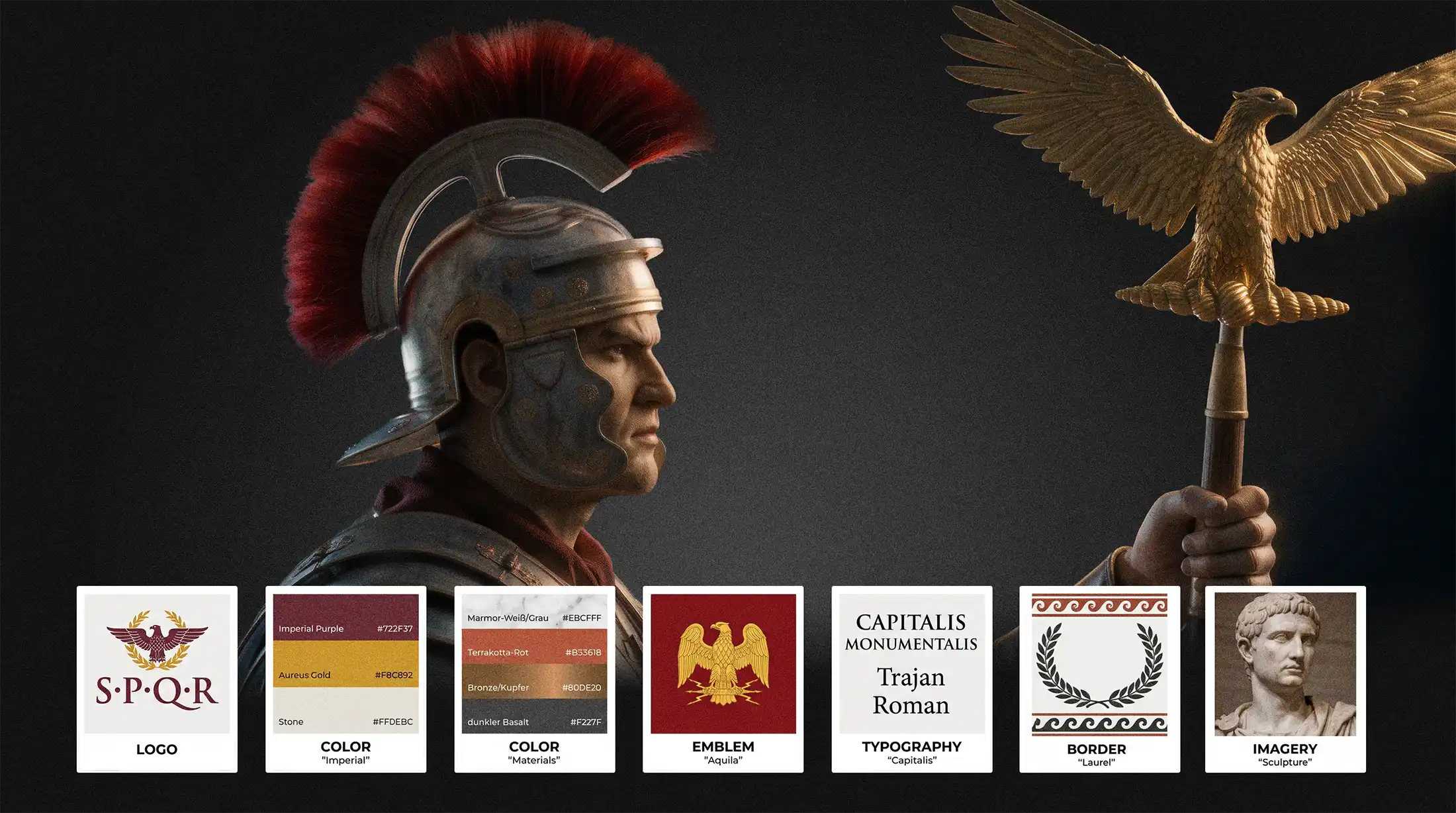
Rome carried that idea to the scale of an empire. S.P.Q.R. stood for Senatus Populusque Romanus, the Senate and People of Rome. It appeared on inscriptions, coins and buildings. It showed who held authority.
3.2 The promise as privilege
Roman citizenship was long a privilege. It brought legal protection and standing. In 212 CE, Emperor Caracalla extended it to nearly all free inhabitants of the empire. Historians still debate his motives and the consequences.
As an analogy, the episode still works. A promise that everyone receives distinguishes no one. Brands know this. Put a premium promise on every product and every price tier, and it thins out.
Two thoughts remain. A sign protects only when it is applied consistently. And a system addresses the people who use it: agencies, developers, marketing teams. The customer should not feel it. The customer should feel reliability.
Mercenary or Partner
What holds in the end
Rome's decline had many causes. One of them concerns every brand that works with external partners.
Historians cite civil wars, fiscal strain, pressure on the borders and epidemics. They weigh these factors differently. There is no single cause.
One point is still instructive. Foreign soldiers had served Rome since Augustus. The auxiliary troops received citizenship after 25 years of service. Rome bound outsiders through belonging.
In the fourth and fifth centuries, that changed. Rome now contracted entire units under their own leaders as allies, the foederati. Loyalty ran through the leader, no longer through Rome.
I work as a freelancer myself, so I work from the outside. I know what this difference looks like. It is not written in any contract. It shows in three things:
- Knowing the why. Whoever understands the reason behind a rule applies it correctly where the manual is silent.
- Having a voice. Whoever may help shape the rules defends them. Whoever only receives them follows them at best.
- Owning the outcome. Whoever is measured by the result thinks beyond the delivery.
An external partner who has these three things is not a mercenary. An employee who lacks them can be one. The risk lies in missing attachment, not in status.
Manifesto
A brand system needs few fixed rules.
It protects what must never vary and leaves the rest open.
It explains its reasons instead of only issuing orders.
It brings outsiders in. It does not distrust them.
Rome held as long as belonging meant something. Brands hold as long as someone knows what their rules stand for.
Defending a system does not take supervisors. It takes people who understand it.

About the Author
These essays are written by Christoph Gey, an independent Creative Director and Digital Product Designer based in Germany. With over 15 years of industry experience, his work focuses on the strategic intersection of premium branding and complex digital products.
Within these articles, he explores the deeper mechanics of design - ranging from brand strategy and user experience to neuroaesthetics. True to the philosophy that form follows meaning, these insights are crafted for decision-makers who believe that enduring brands demand substance, not just decoration.
MORE ESSAYS
Von Restorff Effect
The Von Restorff effect says the odd one out is remembered. But a brand that only looks different, without changing in substance, trades trust for attention. A look at the neuroscience, UX practice and the trap of cosmetic rebranding.
Ben Franklin Effect
Why do we like people more after we have helped them? The Ben Franklin effect turns a simple request into a bond. How it works in people, how brands use it, and what it means for UX design.

Pratfall Effect – neuroscience meets design
Perfection earns admiration. Honesty earns trust. A creative director on the Pratfall Effect, a confession to his boss over a beer, and why the brands we believe are the ones that admit what they are not.

IKEA Effect – design psychology explained
A wobbly chair can be irreplaceable. A flawless handbag can end up at the back of a closet. The IKEA effect explains why and what it means for design in an age of effortless output. Explore the neuroscience behind it.
SELECTED WORK
A curated selection of branding and digital product design projects. My work focuses on creating coherent brand experiences that bridge the gap between human perception and functional utility, helping organizations translate complex strategic goals into enduring digital products.



International Freelance Creative Director & Digital Product Designer
Let's create something meaningful together
I love what I do - for me, design is less of a job and more of a calling. That's why I enjoy working with ambitious individuals and mid-sized businesses just as much as I do with global players. If you bring that same passion to your project, I’d love to hear from you. Let’s find out together how we can take your vision to the next level.