
Essay — Design & Perception
The Noise in the Matrix
Why Perfection Creates No Meaning
On the unease before the almost perfect.
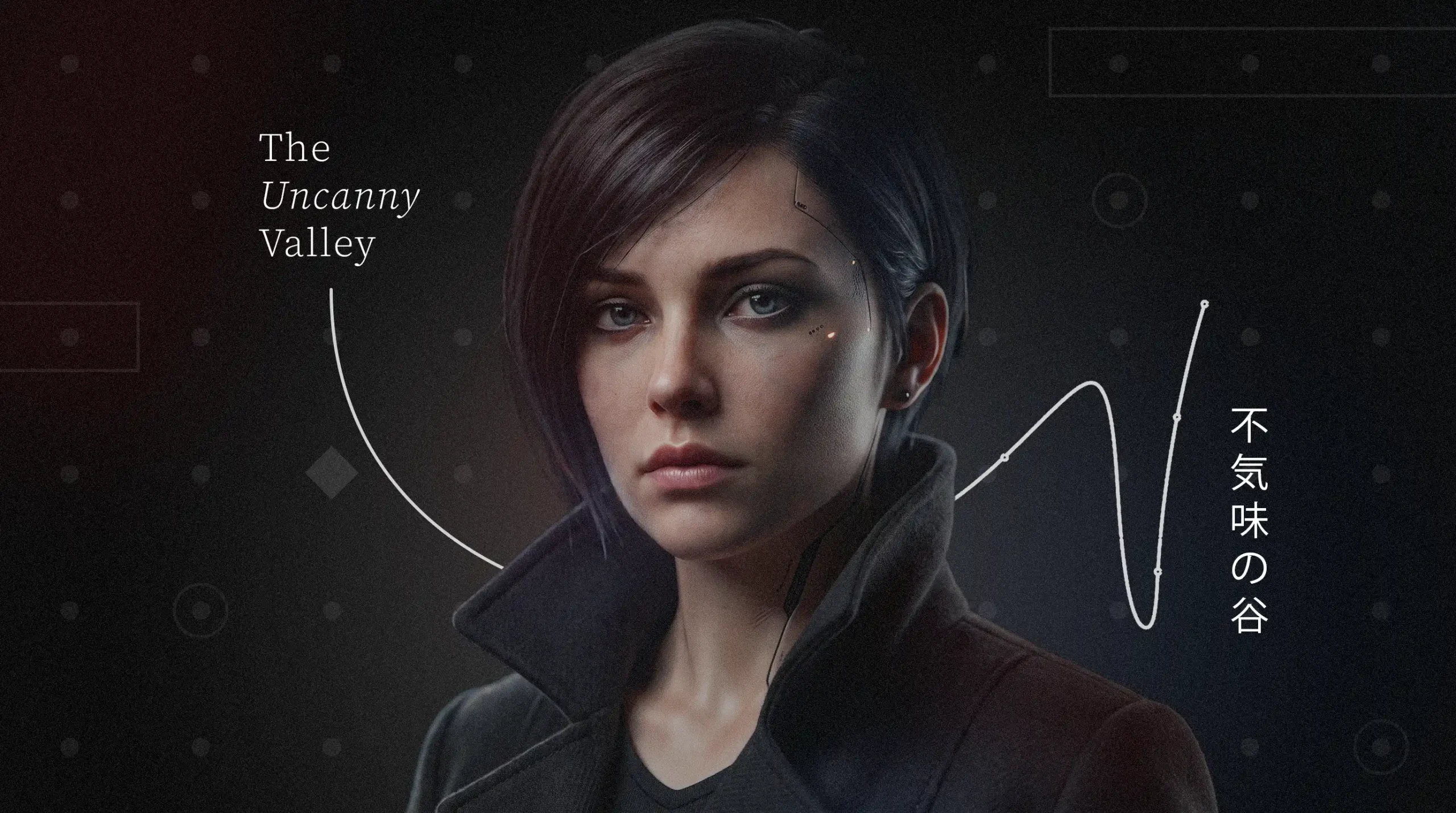
The Uncanny Valley
From Aesthetics to Trust
Theory
There is this one brief moment. You look at an image, a face, a moving model. Before the brain can name the flaw, a gut feeling kicks in. Something is off. It is no dramatic glitch. It is a quiet, disruptive noise.
This phenomenon is called the Uncanny Valley. In 1970, the Japanese roboticist Masahiro Mori put forward a hypothesis: the more human a figure looks, the more familiar it feels to us, up to a certain point. Just short of perfect replication, the curve tips. Acceptance collapses and unease sets in. Only when the figure becomes nearly indistinguishable from a human being does the curve rise again.
Mori’s thesis still fascinates today. The empirical evidence is mixed. What triggers the unease is also disputed. Evolutionary psychology suspects a protective reflex against disease and danger. Neuroscientific approaches point more toward a category conflict or a perceptual mismatch: the brain fails to sort synthesis from reality.
1.1 The Attempt to Force the Valley
In the 2000s, Hollywood set out to overcome the valley with computing power. Films like The Polar Express (2004) and Beowulf (2007) poured hundreds of millions into motion capture to replicate faces exactly. The critics still passed harsh judgment on the waxy, lifeless gazes of the digital protagonists. Technically, the facial expressions were impressive. Emotionally, they were dead.
The lesson is simple: abstraction often creates more empathy than the flawless copy. A reduced cartoon figure clears the valley with ease, because the brain fills the gaps with its own imagination.
1.2 From Aesthetic Valley to Trust Problem
With generative AI, the Uncanny Valley is mostly treated as a transitional problem. Once the algorithms mature, the valley disappears. That falls short. More computing power does not solve the dissonance problem. It shifts it from aesthetics to authenticity.
PracticeI experienced this recently, live. For a mid-sized client, and I cannot say more because of an NDA, we tested a landing page in two variants. The first used photorealistic AI models, the second real people. Both were cleanly executed, the AI images flawless at first glance. The test ran for seven days in live operation, with 3,680 page views in total.
The result: the click-through rate was 13 percent higher for the version with real people. Dwell time was shorter there. We read that as irritation. Anyone who looked at the AI images lingered and searched for what bothered them. That is an interpretation, not proof. It was not a lab experiment, and the sample is modest. As a signal, it is clear enough to take seriously.
What is at work here is not a technical flaw. No sixth finger, no wrong light reflection. People seem to smell AI slop from five kilometers away, upwind. Our sense for it probably sharpens with every synthetic image we meet each day. Often we cannot name the cause: skin that is too smooth, eye contact that sits too perfectly, a touch too much mathematics.
I believe that people want authenticity. When a brand uses AI models, it claims a closeness that does not exist. It reads as a facade. Many viewers feel, probably more unconsciously than not, a little bit betrayed. I suspect the brand loses value as a result. I have not measured that. The test shows the click, not the feeling behind it. But the two fit together.
If synthesis one day becomes indistinguishable, we leave the Uncanny Valley on the technical side. Then we enter a new valley: that of credibility. The question will no longer be: does this look real? But: is it real?
From brands, we do not expect flawless depiction. We expect resonance. And resonance comes from conviction.
The Noise in the Matrix
The Uncanny Valley reminds us that design is not a mathematical approximation of reality. It is no coincidence that illustration, deliberate abstraction and the patina of real photography touch us, while hyperrealism often leaves us cold.
The quiet noise at the sight of the almost perfect is no bug in our perception. It is our finest tool. It separates decoration from conviction.
Whoever wants to rebuild reality with machines stays stuck in the valley of interchangeability. Whoever abstracts deliberately, shows character and allows imperfection creates what can hardly be simulated: meaning.
Perfection is not the same as meaning.

About the Author
These essays are written by Christoph Gey, an independent Creative Director and Digital Product Designer based in Germany. With over 15 years of industry experience, his work focuses on the strategic intersection of premium branding and complex digital products.
Within these articles, he explores the deeper mechanics of design - ranging from brand strategy and user experience to neuroaesthetics. True to the philosophy that form follows meaning, these insights are crafted for decision-makers who believe that enduring brands demand substance, not just decoration.
MORE ESSAYS
Win every pitch
Fifteen years of helping agencies win their dream clients, distilled into 15 tips. Why winning shouldn’t be the goal, why a pitch is only a first meeting, and what really makes a client say yes.
The Liturgy of the Interface
Church bells and push notifications, confession and the Genius Bar: an essay on the psychological architecture shared by ritual and interface design and where the analogy breaks down.
Scarcity and luxury brand discipline
Scarcity isn’t one tactic – it’s three. From fake e-commerce timers to Labubu’s collapse to Chanel’s century-long price discipline, here’s what actually separates them.
Louis Vuitton Design Systems
Louis Vuitton never chose between reach and exclusivity. Iit built a system that separates the two. A design-systems lesson for brand and product teams.
SELECTED WORK
A curated selection of branding and digital product design projects. My work focuses on creating coherent brand experiences that bridge the gap between human perception and functional utility, helping organizations translate complex strategic goals into enduring digital products.




International Freelance Creative Director & Digital Product Designer
Let's create something meaningful together
I love what I do - for me, design is less of a job and more of a calling. That's why I enjoy working with ambitious individuals and mid-sized businesses just as much as I do with global players. If you bring that same passion to your project, I’d love to hear from you. Let’s find out together how we can take your vision to the next level.