Essay — Brand Strategy
Can
Brand Guidelines
hold style?
Brand guidelines describe a brand. Judgment defines it.
Gloves, Sunglasses,
a Ponytail
I can't prove who was driving. That is exactly the point.
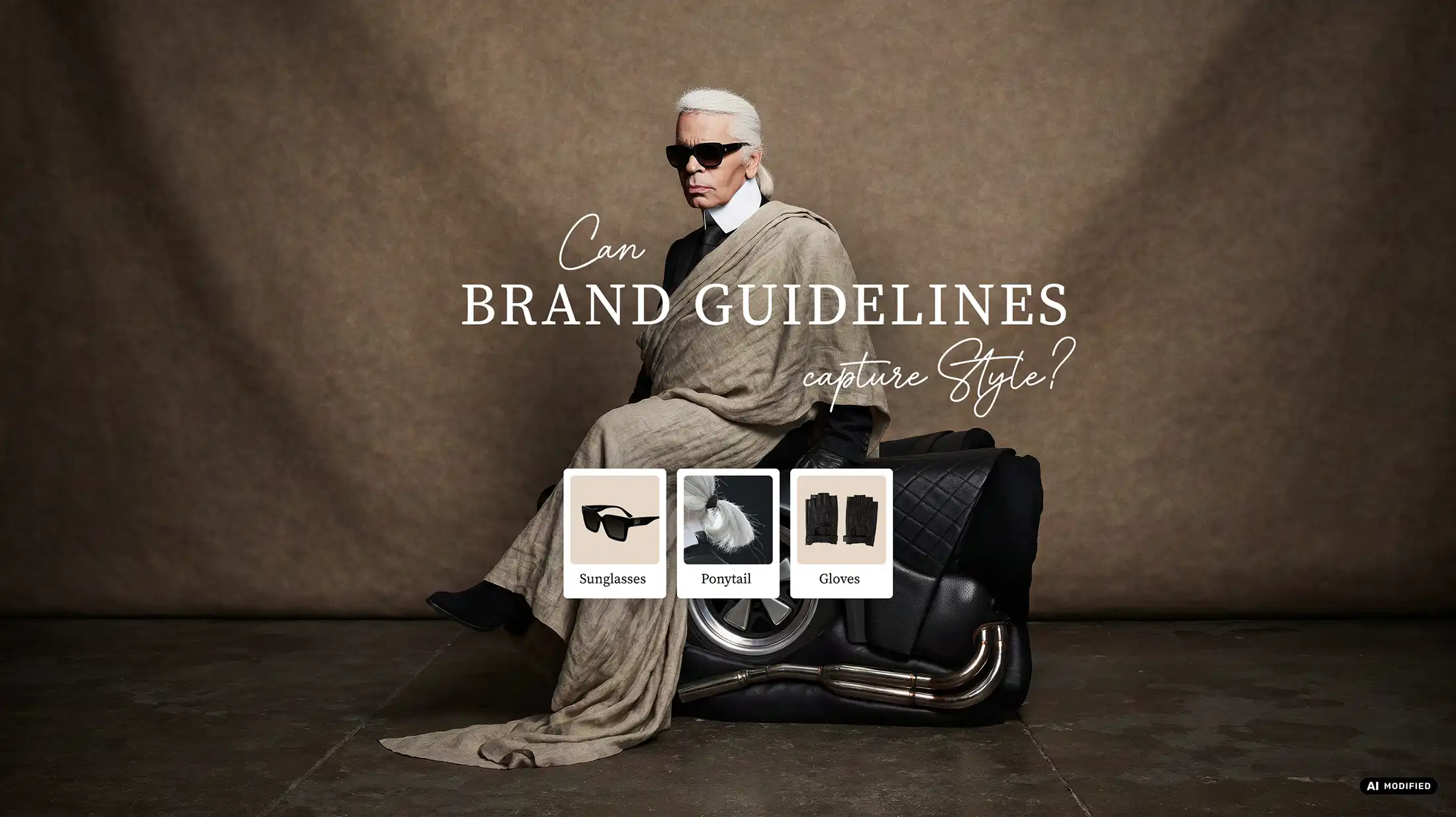
In Düsseldorf, a Porsche once drove behind me. At the wheel sat someone in black gloves and sunglasses, a ponytail in the wind. I could have sworn it was Karl Lagerfeld. I can't prove it.
Three details were enough. An entire world filled my rear-view mirror: Chanel, Fendi, a silhouette the whole industry knew.
Lagerfeld was not a logo. He was not a rulebook. He was judgment you could wear. And that is the problem for every brand that tries to write its style into brand guidelines.
What Brand Guidelines
Can't Capture
Guidelines answer what is allowed. They stay silent on what is right.
Brand guidelines govern the visible: color values, typefaces, spacing, image language. They answer the question What is allowed? They do not answer the question that decides a brand's everyday life: What is right when the rules say nothing?
This is not a flaw of bad manuals. It is their nature. A manual that is too short leaves too much open. A manual that is too long, nobody follows.
And every manual looks backward. It records decisions someone made in the past.
Three Cases
That Prove the Point
Recent evidence from automotive, technology and graphic design. Not one of them is a fashion house.
2.1 Ferrari and LoveFrom
Ferrari spent years building its own design center, and it collected awards for it. For its first electric car, the Luce, the company still brought in an outside studio: LoveFrom, founded by Jony Ive and Marc Newson. Over five years, they worked with Ferrari's internal teams on the exterior and the interior.
The logic seems clear: honor what exists, and still move forward. No manual could have made that call. It took a decision about who should hold the pen.
2.2 Apple, Ive and a Style That Travels
Apple has some of the most thorough design guidelines in the world. Yet when Jony Ive left in 2019, the look did not stay locked in the document.
Years later, Domus described the Luce cabin as an Apple product you can sit in. The style had moved from one brand to another. It never lived in Apple's rulebook. It lived in a person and his team.
Inside Apple, the picture grew less clear. Ive's successor Evans Hankey left in 2022 and was not replaced. Alan Dye, who led interface design from 2015 and presented Liquid Glass in 2025, moved to Meta at the end of that year. Parts of the Apple community reacted with relief.
That reaction says less about who was right than about how personally people read design. Even at a company this size, a style is attributed to people, not to documents.
2.3 Studios That Become the Brand
In graphic design, a studio often carries the handwriting today. Porto Rocha stands behind the Robinhood identity and the Google Gemini branding, along with W Hotels and Nike Run. At this scale, you rarely name one person. A small team judges together, and the judgment is recognizable.
Their judgment becomes the brand. Rules and decisions can be written down in a manual. Still, you can only partly rebuild a brand's character from them.
Can AI Replicate
a Brand's Style?
Only up to a point. It copies what you can describe. It struggles with the rest.
Today, AI can recreate a brand's colors, typefaces, layouts and tone of voice very convincingly. All the components are available. They can be described, and what can be described can be reproduced.
What is harder is exactly what the manual leaves out. A model can produce a thousand variations. Someone still has to decide which one belongs to the brand, which one is too pleasing, and which one has the courage to stay a step ahead.
It also takes sensitivity and experience to form a good judgment, and sometimes to correct the result by hand.
I would put it carefully. AI reproduces what already exists very well. It builds something new only when a human sets the direction. It makes assets cheaper. It does not make judgment obsolete. It makes judgment more valuable, because everything else is suddenly abundant.
What Brands Can Do
About It
Four steps that move judgment out of one head and into the way a brand works.
Practice- Principles, not only rules. Record not just how the brand looks, but why it decides the way it does.
- Document decisions. Include the rejected ones. They show the edge of a style better than any example.
- Don't hide the person. If a brand lives on judgment, it is more honest to anchor that judgment visibly than to pretend the manual carries everything.
- Plan the succession. A creative director should be able to pass on judgment without it turning into a copy.
Who Holds the Pen
Maybe it was Lagerfeld in that Porsche. Maybe not. The question of whether a brand can do without people of judgment is easier to answer. It can keep running. It will stop developing.
As a creative director, I see my job in exactly that: not to guard the rules, but to know when they are no longer enough.
Sources: Dezeen on the Ferrari Luce · Domus on the Luce cabin · Fast Company on Alan Dye · heise on the reactions · Creative Boom on Porto Rocha

About the Author
These essays are written by Christoph Gey, an independent Creative Director and Digital Product Designer based in Germany. With over 15 years of industry experience, his work focuses on the strategic intersection of premium branding and complex digital products.
Within these articles, he explores the deeper mechanics of design - ranging from brand strategy and user experience to neuroaesthetics. True to the philosophy that form follows meaning, these insights are crafted for decision-makers who believe that enduring brands demand substance, not just decoration.
MORE ESSAYS
Self-assessment – When do I need a new corporate design?
Does your brand still fit your company? Discover 7 clear signs it’s time for an update, the difference between a refresh and a rebranding, plus a quick self-test.
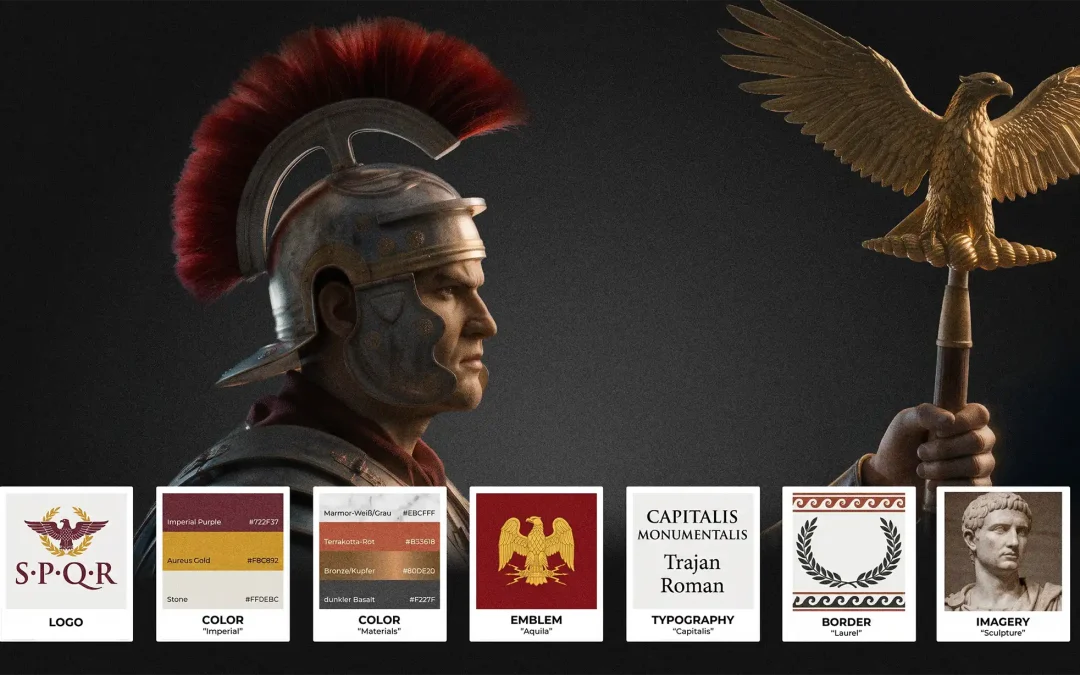
Brand consistency lessons from Rome
Rome ruled five million square kilometres with a handful of fixed rules. What that means for brand consistency, design systems and the freelancers who work inside them.

Von Restorff Effect
The Von Restorff effect says the odd one out is remembered. But a brand that only looks different, without changing in substance, trades trust for attention. A look at the neuroscience, UX practice and the trap of cosmetic rebranding.
Ben Franklin Effect
Why do we like people more after we have helped them? The Ben Franklin effect turns a simple request into a bond. How it works in people, how brands use it, and what it means for UX design.
SELECTED WORK
A curated selection of branding and digital product design projects. My work focuses on creating coherent brand experiences that bridge the gap between human perception and functional utility, helping organizations translate complex strategic goals into enduring digital products.